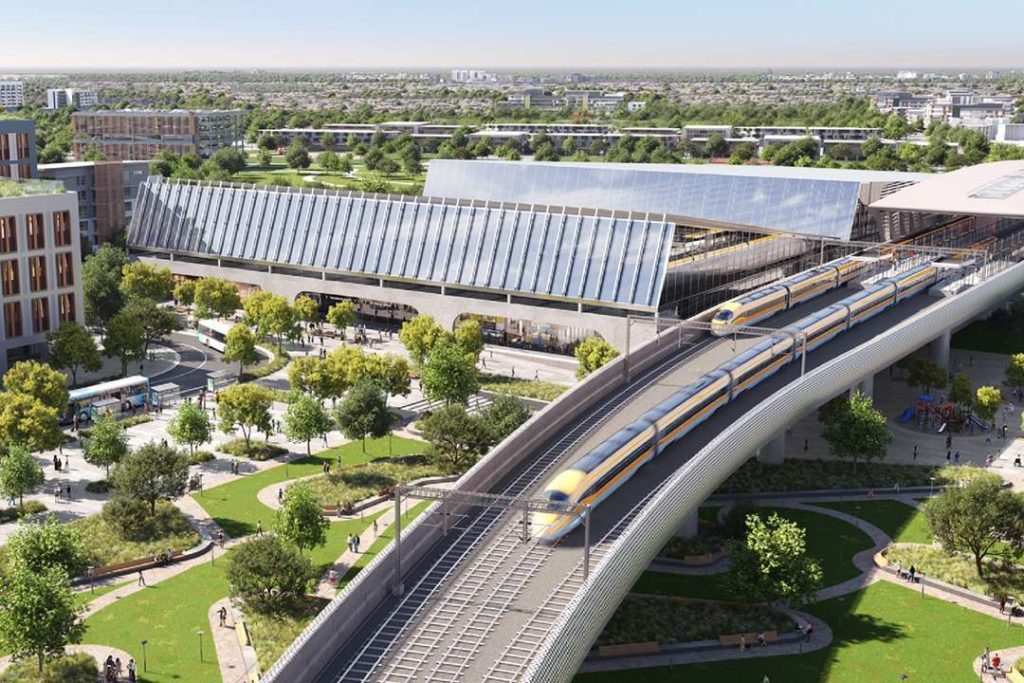
Australia has been talking about high-speed rail for decades. This week it got real again. The Federal Government has kicked off a $659.6m, two-year development phase for high-speed rail between Newcastle and Sydney, aimed at locking in design, approvals, scope and cost so the project can move toward a final investment decision in 2028.
As a buyer’s agent, I love infrastructure. But I don’t love buyers making decisions based on headlines.
So here’s the calm version: what’s been announced, what the timeline really looks like, where impacts are likely to land, and how to buy smart in Metro Sydney while everyone else is chasing the story.

What’s been announced
In plain English, this is what moved:
- The Government committed further funding to detailed planning work over the next two years (the development phase).
- The High Speed Rail Authority released supporting material and a business case for the Newcastle to Sydney line.
- The headline travel times being promoted are around one hour Newcastle to Central Sydney, and around 30 minutes from the Central Coast to either Sydney or Newcastle.
The key word is development. It’s real progress, but it’s not a start date for tearing up half of NSW tomorrow.
Timeline reality check: when could anything actually happen?
Here’s the practical way to think about timing:
- 2026 to 2028: development phase (design, approvals, cost and risk).
- 2028: potential final investment decision.
- Late 2020s: if funded and approved, early construction activities could begin (corridor protection, enabling works, compounds, tunnelling start points).
- Late 2030s: public reporting on business-case material has pointed to services starting around 2039 for the Newcastle to Sydney leg, with later extensions possible.
If you’re buying in Sydney in 2026, the benefit is long-horizon. The disruption can start much earlier, and it’s more localised than people think.
Where the route and stations are proposed
Public material points to a dedicated high-speed rail alignment with proposed stations including:
- Newcastle (Broadmeadow)
- Lake Macquarie (Morisset)
- Central Coast (Gosford)
- Sydney Central
- Parramatta
- Western Sydney International Airport (as a future station/extension)
Independent assessment material also flags the scale of engineering involved, including extensive tunnelling and major bridges and viaducts.
Buyer takeaway: the biggest, clearest impacts tend to cluster around stations and construction interfaces (portals, ventilation, work sites), not across whole suburbs.
The buyer’s agent lens: three impact zones
Infrastructure doesn’t lift markets evenly. It creates zones.
1) Station precinct zone (potential uplift, plus change)
Where it can help: improved access, stronger car-light living, and more demand from people who value speed and convenience.
Where buyers get caught: rezoning and density. Station precincts often mean taller buildings, more apartments, more traffic, and a different feel over time. That can be great. It can also change light, privacy, and quiet streets.
2) Construction interface zone (short-term pain)
This is the unglamorous bit: construction compounds, spoil haulage routes, truck movements, temporary road changes, and years of what’s happening outside my house today.
Properties directly affected by construction interfaces can see value pressure during the build. Not forever, but long enough to matter if you’re buying for lifestyle.
3) Second-order demand shift zone (long-term reshuffle)
High-speed rail can change where people consider living and working. If a one-hour Newcastle to Sydney trip becomes real, more households will compare Newcastle and Central Coast lifestyle against Sydney price points.
That doesn’t mean Sydney becomes cheap or drops. It means some demand gets redistributed at the margin, especially for buyers who are flexible and work hybrid.
So what does this mean for Metro Sydney buyers, specifically?
Most Sydney buyers won’t be directly affected by the corridor itself. The more relevant questions are:
- Do you need to live in Sydney, or do you need to access Sydney? Those are different problems.
- Are you buying near a future station precinct (Sydney Central or Parramatta), where the biggest change is likely to be planning and density rather than the rail line itself?
- How does this fit with the transport layering already happening in Sydney (Metro West, station precinct renewals, road network changes)?
If you’re an Inner West buyer, the high-speed rail story is mostly an ecosystem story. Your direct day-to-day reality is more likely to be shaped by Metro projects, precinct renewal, and local traffic patterns than by a line aiming for the late 2030s.
Metro Sydney: where the upside is more likely to be felt
If we’re being honest, the property impact story in Sydney is less about the track and more about the nodes.
Sydney Central
This is about interchange. If Central becomes a high-speed rail gateway, the main beneficiaries tend to be people who can access Central quickly and reliably. That usually rewards existing rail and metro catchments more than it creates brand new ones.
Parramatta
Parramatta is the bigger medium-term story because it’s already a growth centre with multiple transport layers. If a high-speed rail station becomes part of the mix, you should expect planning attention, precinct change, and potentially more density around key connections.
Western Sydney International Airport (future extension)
Airport connections drive long-term reshaping, but they also bring huge staging and uncertainty. Treat this as a long-horizon story.
Owner-occupiers: how to buy with this in mind (without overpaying)
If you’re buying a home in Sydney, here’s the rule: don’t pay today for a benefit you can’t actually use for 10 to 15 years.
A practical checklist:
- Would you still want the home if the high-speed rail timeline slips by five years?
- If you’re near Central or Parramatta, have you sanity-checked what higher density could mean for your street (light, privacy, traffic, parking)?
- If you’re within walking distance of any major construction interface, have you priced the disruption honestly?
- Are you buying a home that works for your real week (school run, work commute, sleep), not a future brochure?
Investors: the opportunity is real, but the trap is familiar
High-speed rail headlines can trigger the usual investor temptation: buy the story, not the asset.
The better approach:
- Buy a defensible property first (light, layout, parking, low-maintenance profile).
- Treat any future rail uplift as optional upside, not the whole thesis.
- Watch supply pipelines around station precincts. More apartments can cap growth for undifferentiated stock.
- Stress test cash flow. If the hold is long, you need buffers that survive rate cycles and vacancy.
Can high-speed rail increase and devalue property?
Yes, both can be true.
- Station precincts can increase demand and amenity over time, but they can also bring more density and competition.
- Construction interfaces can temporarily devalue properties that wear noise, truck routes, and disruption.
- Corridor protection and property acquisition risk can create uncertainty in specific micro-locations.
The key is micro-location. Infrastructure is not a suburb-wide story. It’s a block-by-block story.
FAQs: Sydney to Newcastle high-speed rail (2026)
When will construction start?
The Government is funding a two-year development phase to make the project construction-ready and inform a final investment decision in 2028. Early enabling works could follow if funded and approved.
When would trains run?
Public reporting on business-case material has pointed to late-2030s timing for services on the Newcastle to Sydney leg, with later extensions possible.
Where are stations proposed?
Public material references stations including Broadmeadow, Morisset, Gosford, Sydney Central, with Parramatta and Western Sydney Airport referenced as future stations/extension.
Will it affect Sydney house prices?
Not evenly and not immediately. The most direct effects are around station precincts and construction interfaces.
Is there any impact on Sydney’s Inner West?
There’s unlikely to be a direct alignment impact in the Inner West. The more relevant story is Sydney’s broader transport layering.
What should buyers do now?
Don’t buy on hope. Buy a property you’d be happy with even if the timeline slips.
The calm conclusion
High-speed rail between Sydney and Newcastle is moving further than it has in a long time. That’s worth acknowledging.
But buyers don’t win by chasing headlines. They win by buying the right asset, in the right pocket, with the right plan and a buffer for reality.
General information only. This isn’t financial or legal advice.
Further Reading
- Minister for Infrastructure media release (2026): Newcastle–Sydney HSR development phase and funding.
- High Speed Rail Authority library and Newcastle–Sydney project material.
- Infrastructure Australia Stage 3 evaluation report (HSR Sydney–Newcastle).
Kevin Parker is a Sydney buyer’s agent and the founder of Parker Hadley, helping owner-occupiers and investors buy with calm, evidence-based advice. Based in Sydney’s Inner West, Kevin has lived in Balmain and Rozelle since 2012 and supports clients across Rozelle, Balmain, Leichhardt, Annandale, Glebe and the broader Sydney market. If you want a clear plan before you bid, we can help.