Five Dock’s always been a proper Inner West village. Great North Road is busy, the food is elite, and the suburb’s got that rare mix of old-school homes and people who actually use the footpath. Now it’s getting rail for the first time, via Sydney Metro West. That’s a big deal.
But if you’re buying here, the important part isn’t the headline. It’s the map. Because the wins (and the headaches) don’t land evenly across the suburb. A metro can be a tailwind, but it can also be a long, dusty, traffic-managed slog for the wrong street.
Buyer’s agent disclaimer: nobody gets a crystal ball. What we can do is reduce guessing by reading planning, access, supply and disruption properly.

Project snapshot
| Project | Sydney Metro West (new metro line between Westmead/Parramatta and the Sydney CBD) |
| Five Dock station | One new underground station serving Five Dock and surrounds |
| Where is it? | Off Great North Road, between East Street and the corner of Second Avenue and Waterview Street |
| Main entrance | Fred Kelly Place, off Great North Road |
| Opening target | Sydney Metro West is targeting an opening date of 2032 |
| What changes before opening | Construction disruption, precinct planning, and a new supply pipeline well before the first train. |
What is Sydney Metro West, in plain English
Sydney Metro West is the next big metro line, running from Westmead and Parramatta through the middle ring to the CBD. The confirmed station list includes Westmead, Parramatta, Sydney Olympic Park, North Strathfield, Burwood North, Five Dock, The Bays, Pyrmont and Hunter Street in the CBD.
For Five Dock, the headline is simple: a fast, direct rail link that this area hasn’t had before. Sydney Metro also describes Five Dock Station as enabling a fast and direct trip to the Sydney CBD, with an easy interchange to the local bus network along Great North Road.
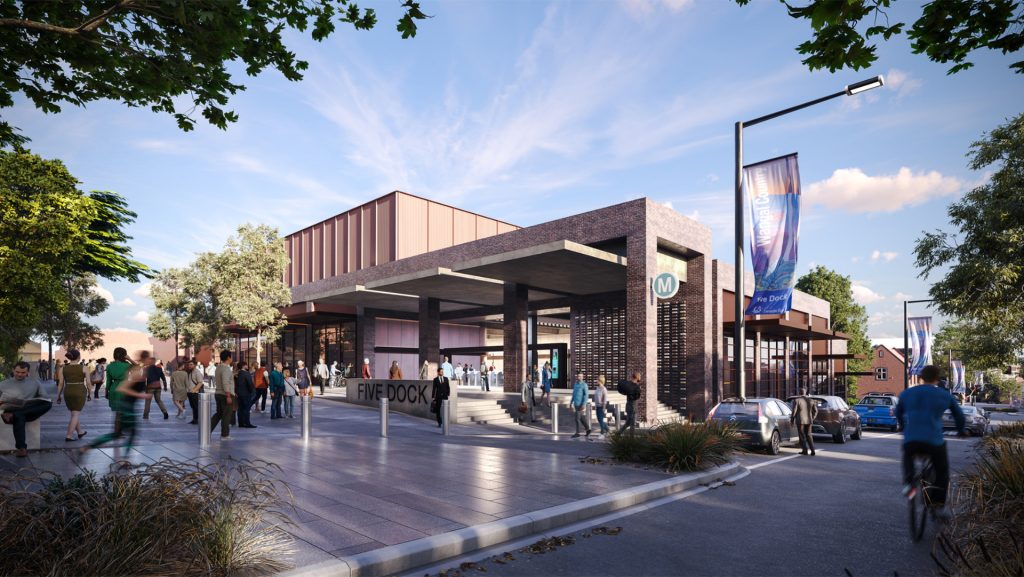
Five Dock Metro Station location and access
- The station is located off Great North Road, between East Street and the Second Avenue/Waterview Street corner.
- There’s one planned station entrance at Fred Kelly Place, off Great North Road.
- The station is intended to integrate with the existing village feel and council urban design recommendations for the town centre.
For buyers, this matters because ‘near the station’ isn’t a circle on a map. It’s a walking route. If your walk is unpleasant (noise, crossings, no footpath shade, traffic), you won’t use it. If you won’t use it, don’t pay a premium for it.
What’s happening right now (and what that means for inspections)
Right now the visible works are very ‘unsexy but essential’. Utility relocation, site preparation, and traffic management. This is the part that most buyers ignore, and then act surprised when their Saturday morning inspection includes a jackhammer soundtrack.
- Utility relocation and site maintenance works typically run 7am–6pm weekdays and 8am–6pm Saturdays (conditions permitting).
- Some out-of-hours work can happen when services need to be tested and transitioned.
- Localised impacts can include temporary footpath closures, parking changes, lane closures, saw cutting, trenching in footpaths and driveway access management.
If you’re buying in Five Dock in the next 12 to 24 months, go and stand on the streets that will carry the temporary pain. Second Avenue, Waterview Street, Great North Road and the immediate side streets are the obvious ones. Noise, dust, parking pressure and heavy vehicles are not theoretical. They’re part of the deal for a while.
The common mistake: treating Five Dock as one market
The lazy take is, “Metro is coming, prices go up.” Sometimes that’s true. Sometimes you pay for the story and wear the downside. Five Dock will behave more like a set of micro pockets than one uniform market, especially during the construction years and the first wave of nearby redevelopment.
- Access changes are real, but the benefit depends on how you actually live. If you don’t commute to the CBD or Parramatta, the metro is a smaller part of your daily life.
- Supply will increase in the broader station catchment. More apartments can be great for a suburb, but it changes competition and resale dynamics.
- Some streets will feel more active and more convenient. Others will feel busier, more parked out, and more ‘through traffic’ than they do today.
Why precinct change usually follows a station
Here’s the reality. Governments build metro stations to move people efficiently. Planning systems then respond by concentrating more housing and mixed-use development around them. That’s not a moral judgement, it’s just how the math works.
So if you’re buying in Five Dock, you need to hold two ideas at once:
- The village amenity can improve over time (better public domain, more shops that people actually use, stronger local services).
- The built form can change, sometimes quickly, especially on larger lots and along key corridors where development becomes viable.
That’s why we keep banging on about the map. You’re not just buying a house. You’re buying a future streetscape and the transition period in between.
What tends to lift value near a new metro station
- Walkability to the station without being on a noisy, high-traffic strip.
- A good street feel: trees, consistent housing stock, decent footpaths and low rat-running.
- Homes with genuine scarcity: sunlight, privacy, parking, outdoor space, and a floorplan that works.
- Amenities that get better, not just more crowded: cafés, services, parks, and better public domain.
In other words, the metro amplifies what’s already good. It doesn’t magically fix a compromised asset.
What can quietly hurt value (or liveability) during the transition
- Years of construction near your street, including utility works and heavier station works.
- Parking pressure: construction workers, displaced parking, and eventually more residents in the broader area.
- Traffic pattern changes on feeder streets, especially where people try to avoid Great North Road.
- Apartment oversupply risk for generic stock. If your unit is average, a wave of newer stock nearby makes resale harder.
- Loss of privacy or light if future built form changes at the end of your street.
Owner-occupiers: how to buy well in Five Dock with a metro coming
Most owner-occupiers want the metro as an option, not a daily stress. The sweet spot is usually walkable, but not right on top of it. Think a comfortable 8 to 15-minute walk, not a 90-second sprint across Great North Road.
Also, remember the Inner West truth: we don’t buy houses, we buy neighbourhoods. So if your daily life is cafés, schools, parks and the Bay Run, make sure your property still nails those basics, metro or not.
A practical owner-occupier checklist
- Walk your route to the future entrance at Fred Kelly Place at peak hour and late evening. Does it feel safe and pleasant?
- Check whether your street is likely to become a feeder route. If it already has rat-running, expect more of it.
- If you’re buying a house, look at privacy and overshadowing risk from potential future development on nearby larger lots.
- If you’re buying an apartment, prioritise natural light, ventilation, aspect, and parking. ‘Near the metro’ won’t save a dark box.
- Be honest about construction tolerance. If you’re noise-sensitive, don’t buy right next to the works and pretend you’ll be fine.
Investors: where the opportunity is, and where it’s a trap
A metro station can strengthen rental demand, especially for tenants who want a car-light life with quick access to jobs. But it can also bring more competing stock, including newer apartments and potentially build-to-rent. That means the asset has to stand on its own.
- What tends to work: boutique blocks and well-designed apartments with light, parking and a layout that suits renters long-term.
- Also works: houses or semi-style stock on calm streets that are close enough to the village and station, but not in the construction blast zone.
- Be careful with: generic units with poor aspect, no parking, and no point of difference. In a higher-supply future, ‘average’ becomes risky.
If you’re investing, a good question is: “What’s my tenant choosing this over?” If the answer is ‘a brand new building two blocks away’, you need a point of difference.
How we’d ‘read the map’ before recommending a property
- Access: distance to the station entrance, and the quality of the walking route (crossings, noise, footpath feel).
- Disruption: known construction areas, likely staging zones, and streets with temporary traffic management.
- Future built form: what’s possible nearby under planning controls, not just what’s there today.
- Supply: what new housing is likely to arrive in the broader catchment, and what that means for resale or rental competition.
- Liveability: light, privacy, parking, outdoor space, and whether the home feels calm inside.
The point isn’t to be pessimistic. It’s to be realistic. Metro projects are transformative, but they’re messy while they’re happening.
Timeline reality check
Sydney Metro West is targeting 2032 for opening. That sounds far away. But the precinct change starts earlier. Construction, utility works, traffic management, and the early wave of planning activity all happen years before the first service.
If you’re buying now, your decision isn’t ‘will the metro open’. It’s ‘what do I want my day-to-day to feel like during the messy middle’. That’s where most buyers either buy well, or buy a story and regret the noise.
The calm conclusion
Five Dock getting a metro is objectively significant. It’ll change access, housing supply, and the shape of the village over time. But the upside isn’t automatic. It’s street-by-street.
If you’re considering buying in Five Dock or the surrounding pockets that feed into the station catchment, this is exactly the kind of risk map we walk through with clients. Not hype. Just practical clarity.
Sources and further reading
- Sydney Metro West project overview (Sydney Metro).
- Five Dock Station page, including station location, entrance and integration notes (Sydney Metro).
- Five Dock Monthly Construction Update, February 2026 (Sydney Metro West PDF).
- Laing O’Rourke: Stations Package West announcement noting Metro West opening target of 2032 (January 2026).
Kevin Parker is a Sydney buyer’s agent and the founder of Parker Hadley, helping owner-occupiers and investors buy with calm, evidence-based advice. Based in Sydney’s Inner West, Kevin has lived in Balmain and Rozelle since 2012 and supports clients across Rozelle, Balmain, Leichhardt, Annandale, Glebe and the broader Sydney market. If you want a clear plan before you bid, we can help.