The Tuesday Test: Why a slower Inner West market could help buyers make better decisions
Reading time 10 minutes
by Parker Hadley
- Sydney’s property market has clearly lost some heat. Prices softened again in June, auction clearance rates dropped sharply, and the panic has come out of some buyer conversations.
- But a slower market is not automatically an easy market. Good Inner West homes are still scarce, borrowing power is still under pressure, and sellers of quality homes do not suddenly forget what they own.
- The better opportunity for home buyers may not simply be ‘buy cheaper’. It may be ‘buy better’. A slower market can give you something more useful than a discount: time to think.
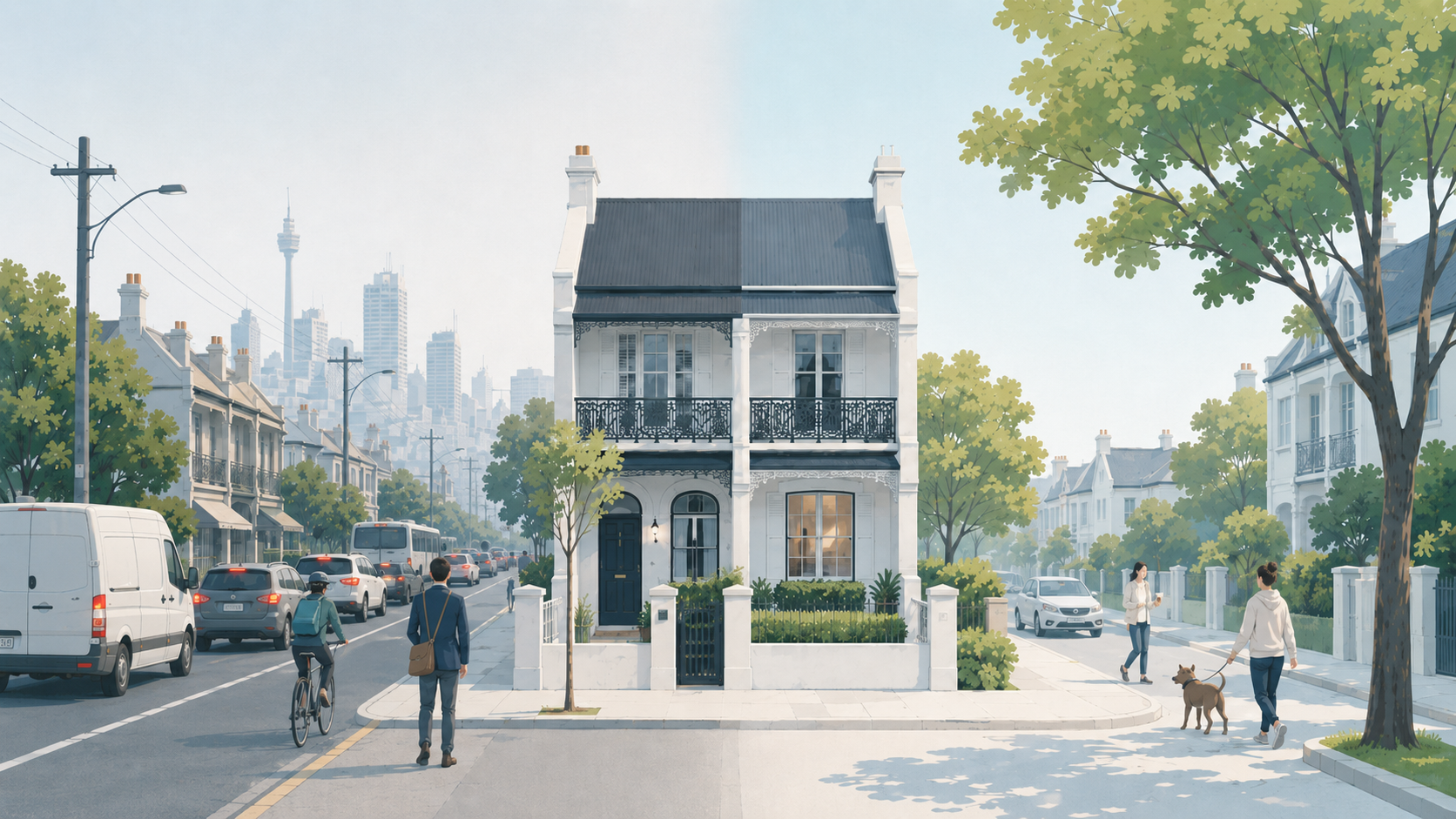
- That’s where the Tuesday Test comes in. Saturday sells the dream. Tuesday tells the truth. If a home works on a normal Tuesday, the school run, the commute, the dog walk, the groceries, the rain, the parking, the working-from-home day, it is far more likely to work for real life.
Buying a home in Sydney?
See how we help buyers narrow the search, assess properties properly and negotiate with confidence.

The Inner West market is slower. Good. Now use it properly.
There is no need to pretend the Sydney market is roaring along. It is not. The question is what buyers do with that information.
PropTrack’s June 2026 Home Price Index reported that national home prices fell for a third month running, down 0.3% in June, while Sydney recorded one of the sharper capital city falls at 0.5% for the month. PropTrack also pointed to three interest rate rises reducing buyer borrowing capacity.
Auction conditions have cooled too. ABC News reported that Cotality’s late-June figures put Sydney’s preliminary clearance rate at 47.3%, the city’s lowest since April 2020, with fewer than half of homes taken to auction finding a buyer that week.
And the Reserve Bank is not exactly waving everyone back into the market with a party popper. In June, the RBA held the cash rate at 4.35% after three increases earlier in the year, while noting that financial conditions had tightened and housing prices were falling in some capital cities.
So yes, the market is slower. Buyers have a bit more breathing room than they did when everything felt like a Saturday morning sprint.
But that does not mean every Inner West home is suddenly cheap. It does not mean every vendor is desperate. And it definitely does not mean buyers should switch their brains off because the market feels softer.
A slower market gives you more room to think. That is the opportunity.
Saturday sells the dream. Tuesday tells the truth.
Open homes are designed to make a property feel good. The lights are on. The house is clean. The agent is polished. The coffee nearby is decent. The street has that Inner West charm doing all the heavy lifting.
And of course buyers are allowed to feel something. Buying a home should be emotional. You are not buying a toaster.
The problem is when the Saturday version of the home becomes the only version buyers assess.
You do not live in a Saturday morning inspection. You live in the Tuesday version of the home.
That is the 7.30am school run, the wet commute, the groceries after work, the dog walk, the bin night, the neighbour noise, the parking search, the WFH calls, the awkward stairs, the afternoon heat, the lack of storage, and the moment when you realise the prettiest room in the house is not actually the room you will use most.
That is the Tuesday Test.
A home does not just need to photograph well. It needs to live well.
In the Inner West, the suburb name only tells part of the story
This is especially true around the Inner West and the nearby peninsula suburbs. Rozelle, Balmain, Birchgrove, Lilyfield, Annandale, Leichhardt, Glebe, Drummoyne, Five Dock, Haberfield, Summer Hill and Dulwich Hill all have pockets that can feel completely different from one street to the next.
Two homes can both be ‘close to shops’. One might have a flat, pleasant walk to the village. The other might involve an annoying crossing, a noisy road, a hill that gets old quickly, or a route you would not actually want to do at night.
Two terraces can both be ‘full of character’. One might have usable light, decent storage and a floorplan that works for modern life. The other might be charming for 10 minutes and annoying for 10 years.
Two apartments can both be ‘near transport’. One might give you practical, walkable convenience. The other might give you more noise than benefit.
That is why the slower market matters. When buyers have more time, they can stop buying the suburb name and start testing the actual life that comes with the home.
The homes worth chasing are often the low-friction ones
This is not the sexiest phrase in property, but low-friction homes are often the ones people end up loving most.
They make ordinary life easier. They are not necessarily the flashiest property at the inspection. They are the ones where the walk makes sense, the floorplan works, the light lands where it should, the noise is manageable, the parking reality is understood, and the daily routine feels simple rather than constantly compromised.
That matters even more in the Inner West because the appeal of the area is not just the house. It is the way the house plugs into everything around it.
The new GreenWay is a good example. Inner West Council says the GreenWay is a six-kilometre environmental, walking and cycling corridor linking the Cooks River at Earlwood with the Parramatta River at Iron Cove and the Bay Run, with the full route from Parramatta Road through Lewisham West and Dulwich Hill to the Cooks River now open.
That kind of infrastructure can genuinely change how people move through a suburb. But it also makes the detail more important. Are you near a useful connection, or near the busy bit without the benefit? Is the route something you will actually use, or just something that sounds good in the listing copy?
The same logic applies to Metro West. Sydney Metro says the project will be a 24-kilometre underground railway, with confirmed stations including Five Dock, The Bays, Pyrmont and Hunter Street, and a target opening date of 2032. Buyers will price parts of that future early, but the day-to-day question still matters. What do you actually want life to feel like during the messy middle?
Bays West is similar. The Stage 1 Master Plan and Rezoning Package were approved in December 2022, with planning controls guiding a future new centre around the future Bays Metro station and White Bay Power Station. Great. But if you are buying nearby, the smart question is not just ‘will this area change?’ It is ‘will this specific home benefit from that change in a way that suits my life?’
That is what the Tuesday Test is really trying to uncover.
Buying a home in Sydney?
See how we help buyers narrow the search, assess properties properly and negotiate with confidence.
Planning reform will change the conversation, but not every home equally
There is also a bigger planning story unfolding across Sydney. The NSW Low and Mid-Rise Housing Policy is designed to encourage more dual occupancies, terraces, townhouses, apartments and shop-top housing in residential areas within 800 metres walking distance of nominated town centres and transport hubs. The NSW Government says the policy is expected to deliver up to 112,000 homes across the state over five years.
For Inner West buyers, that does not mean every street is about to turn into a construction site. It also does not mean established homes suddenly lose their appeal.
It means buyers need to get better at reading the street, the zoning, the surrounding lots, the local centre, the transport access, the heritage controls, and the likely path of change.
Some homes may benefit from better nearby amenity over time. Some may become more exposed to development disruption. Some may sit in pockets where character, scarcity and daily convenience keep supporting demand.
Again, the answer is not panic. It is better questions.
The Tuesday Test checklist
If the slower market gives you a little more time, use it. Before getting too attached to the Saturday version of a property, test the Tuesday version.
1. Test the street outside inspection hours
Go past at 7.30am, 3.30pm and 7pm if you can. You are looking for the rhythm of the street, not just the look of the street.
2. Walk the actual routes
Do the walk to the shops, school, park, ferry, bus, light rail or future metro area. Do not just rely on the map. A technically short walk can still be a miserable one.
3. Check the parking reality
If the home does not have proper off-street parking, understand what it feels like when everyone else is home. Saturday at 10am may tell you very little.
4. Think about weather
Will the home still work on a rainy Tuesday night? Where do wet shoes, school bags, prams, scooters, dogs and umbrellas go?
5. Test the floorplan for normal life
Can two people work from home? Can someone sleep while someone else is on a call? Is the bathroom in a silly spot? Is the laundry actually usable?
6. Follow the light
Not just the light at inspection time. The light in the spaces you will actually use, at the times you will actually use them.
7. Look for useful future upside, not brochure upside
GreenWay, Metro West, Bays West and planning reform all matter. But the question is whether they improve your daily life from this specific home. Future amenity is only useful if it is actually useful to you.
8. Ask whether the home gives you calm
This is less measurable, but important. A good home should make ordinary life easier. If every part of the property needs an excuse, there is probably a reason.
A slower market does not mean you should wait forever
There is one trap in a softer market worth calling out. Some buyers get so focused on waiting for the perfect moment that they miss the point of the extra breathing room.
The point is not to sit on the sidelines forever. The point is to be better prepared when the right home appears.
If you have your finance in order, know your non-negotiables, understand the suburbs you are targeting, and can recognise a low-friction home when it comes up, a slower market can be genuinely helpful.
Not because every property becomes cheap. Because you may get a little more time to make a decision properly.
That is different. And much more useful.
Kevin’s take
Everyone wants to know whether the market is up, down or sideways. Fair enough. But once you have answered that, you still need to answer the more important question: is this the right home?
A slower market can make buyers feel like the job is just to negotiate harder. Sometimes that is true. Sometimes it is not. The bigger win is often having enough time to work out whether the property actually suits your life.
The Inner West can be funny like that. Two homes can look similar online and live completely differently. Same suburb, similar price, similar bedrooms, totally different Tuesday.
So yes, use the softer market. But do not only use it to chase a discount. Use it to check the street, test the walk, understand the noise, read the reports, think about the floorplan, and make sure the home still works when the Saturday inspection glow wears off.
A good buy is not always the one with the biggest discount. Sometimes it is the one that makes normal life better for the next 10 years.
Buying a home in Sydney?
See how we help buyers narrow the search, assess properties properly and negotiate with confidence.
Related insights

Peninsula & Bays Property Pulse October 2026
What the September RBA Decision Could Mean for Sydney Buyers Before Summer