House vs Unit vs Townhouse: Which Makes the Best Investment Property in Australia?
Reading time 14 minutes
by Parker Hadley
If you’re buying an investment property in Australia, asset type matters more than most people realise. You can pick the right city, the right suburb and even the right price bracket, then still buy the wrong property. That’s one of the more expensive ways to be nearly correct.
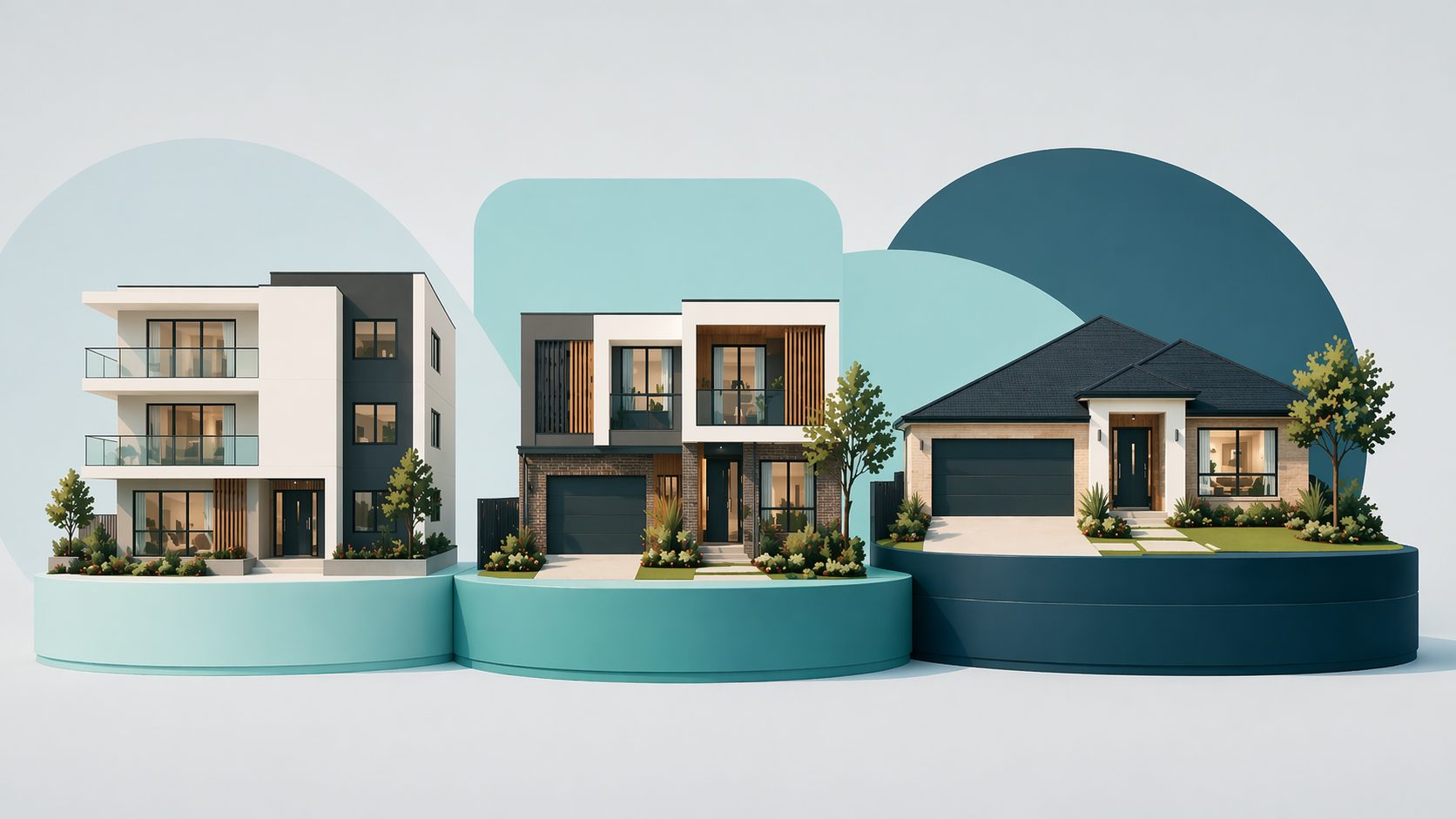
My broad view is simple. If the budget allows, a quality house is usually the strongest long-term investment property. Not because houses are magical. Because in most markets they give you more land, more scarcity, more flexibility and a deeper pool of future buyers.
That said, houses aren’t automatically better just because they’re detached. A poor house in a weak location can still be a poor investment. Townhouses can be a smart second option when they give you access to a better market or tenant pool. Units can work too, but only when the case is genuinely strong and the due diligence is much tighter.
The real question isn’t whether houses, units or townhouses are ‘best’ in the abstract. It’s which asset type best fits your budget, strategy, target market and holding capacity.
Thinking about investing?
See how we help investors shape the strategy, choose the right market and buy well Australia-wide.

That’s the bit that matters.
Quick version
For most long-term residential investors, my starting order is:
- House
- Townhouse
- Unit
A house is usually the preferred option because it gives you more direct exposure to land, better scarcity and stronger long-term buyer appeal.
A townhouse can make sense when a good house in the right market is out of reach, but the townhouse still has solid tenant appeal, a practical layout and manageable strata risk.
A unit can absolutely work, but only selectively. The building, strata records, floor plan, natural light, owner mix, supply pipeline and resale competition all matter a lot more.
Put simply, buy the best land-backed asset your budget can sensibly afford in a market with real tenant and resale demand.
Not the newest thing. Not the glossiest brochure. Not the one with the friendliest rent estimate.
The best asset.
Why asset type matters so much
A lot of investors spend all their time asking where to buy and not nearly enough time asking what to buy once they get there.
Location obviously matters. But asset type shapes a huge part of the investment outcome. It affects capital growth potential, tenant demand, maintenance, holding costs, resale depth, land value and how much control you actually have over the asset.
A detached house, townhouse and unit in the same suburb can behave completely differently over ten years. Different tenant pools. Different maintenance profiles. Different resale markets. Different upside. Different headaches.
That’s why a suburb guide on its own isn’t enough. You don’t buy a postcode. You buy one title, one floor plan, one maintenance profile and one future resale story.
A quick comparison
| Asset type | Best suited to | Main strengths | Main watch-outs | My view |
| House | Long-term growth investors | Land, scarcity, control, future buyer appeal | Higher entry price, maintenance, lower yield in some markets | Preferred option if the budget allows |
| Townhouse | Investors needing a middle ground | Better affordability than houses, more space than units, decent family appeal | Strata, shared walls, supply risk, quality varies massively | Good second option if well selected |
| Unit | Budget-limited or location-driven investors | Lower entry price, often stronger gross yield, access to expensive areas | Strata, defects, oversupply, weaker land value, resale competition | Selective only, with much tighter due diligence |
Why houses are usually the strongest long-term investment
If the budget allows it, I generally prefer houses for long-term residential investing.
The reason is simple enough: land. Buildings age. Kitchens date. Bathrooms crack. Roofs start having opinions. Land is usually the scarce part of the asset, and in established markets scarcity is what gives property real long-term strength.
A quality house usually gives you broader buyer appeal too. Families want it. Upsizers want it. Owner occupiers want it. Investors want it. Sometimes developers want it. That depth matters when it’s time to sell.
You also get more control. You’re not waiting for a strata committee to decide whether the building insurance is sensible, whether the capital works fund is healthy, or whether everyone would like to spend a fortune on something deeply unnecessary in the lobby.
That doesn’t make houses easy. They cost more. They need maintenance. They can still be poor investments if the location, block or condition is wrong.
But all else being equal, a good house usually gives you the strongest long-term foundation.
Why houses tend to outperform over time
- Scarcity. In established suburbs, well-located detached housing is harder to create than more apartment stock.
- Flexibility. Houses are easier to improve, extend or reposition over time, subject to planning and budget.
- Buyer depth. More buyer groups care about them later, which helps resale.
- Control. Fewer shared decisions, fewer strata dramas, fewer expensive surprises signed off by strangers.
The catch: not every house is investment-grade
This is where people get themselves in trouble. They hear ‘land is king’, then immediately decide any detached house must be a better investment than anything else.
Nope.
A bad house is still a bad investment. A poor street, compromised block, major structural issue, flood risk, awkward layout or weak tenant appeal can all wreck the case.
So when I’m assessing a house, I still want to see sensible location fundamentals, strong tenant demand, future buyer appeal, usable land, manageable condition, realistic rental evidence and a price backed by comparable sales.
I prefer houses, yes. I do not prefer rubbish houses just because they happen to have a patch of grass attached.
When a townhouse makes sense
A townhouse is often the acceptable compromise. Not a bad compromise. Just a compromise.
If a quality house in the target market is out of reach, a well-selected townhouse can be a very sensible next step. It can give you access to a stronger suburb, a better school catchment, a cleaner tenant profile or a more established location than your budget would buy in detached housing.
The good townhouse usually has a practical floor plan, decent natural light, private outdoor space, sensible storage, secure parking and broad appeal to families or professionals.
The bad townhouse feels like an expensive unit with stairs. Awkward layout, no privacy, too many identical neighbours, too much strata and not enough actual differentiation.
That’s the distinction.
What I like in a townhouse
- well-located, established setting
- low or moderate density rather than a giant complex
- practical layout with usable bedrooms
- good light and decent outdoor space
- reasonable strata fees
- strong tenant and resale appeal
- something that behaves more like a house substitute than a dressed-up unit
When a unit can make sense and when it usually doesn’t
Units are where investors need to be much more selective.
The upside is obvious. Lower entry price, easier access to expensive locations and often a stronger gross rental yield on paper. That’s why so many investors drift toward them.
But the list of things that can go wrong is much longer. Strata levies. Special levies. Building defects. Cladding issues. Lift costs. Oversupply. Weak land value. Investor-heavy buildings. Resale competition from twenty near-identical neighbours.
A good unit is usually in a smaller, established, well-maintained block, in a location with deep tenant demand and limited competing supply. It has good light, a practical layout, sensible levies and a resale market that isn’t paper-thin.
A weak unit is often sold on convenience, yield and shiny finishes while quietly carrying all the risk in the fine print.
Units I would be cautious about
- high-rise towers with lots of identical stock
- investor-heavy complexes
- off-the-plan apartments
- buildings with expensive facilities and high operating costs
- areas with a large future apartment pipeline
- tiny or awkward floor plans with narrow buyer demand
- anything where the strata report reads like a horror novel
Why land value matters so much
The building is the part that wears out. The land is usually the part with scarcity.
That’s why houses tend to have the edge. They give you more direct exposure to land. Townhouses give you some. Units give you much less, and that exposure is shared across more owners.
This doesn’t mean the dwelling itself is irrelevant. It still needs to be rentable, maintainable and easy enough to insure. But over time, the land component usually does a lot of the heavy lifting in capital growth.
That’s also why I get nervous when investors focus too heavily on shiny finishes or a brand-new building. A glossy apartment in a corridor where plenty more apartments can be built doesn’t suddenly become scarce because the brochure had nice lighting.
Why rental yield can flatter a weak asset
One of the reasons units keep pulling investors in is yield. The purchase price is lower, the weekly rent can look healthy enough, and suddenly the spreadsheet is smiling at everyone.
Helpful, that.
But gross yield is only the starting point. Once you add strata levies, maintenance, vacancies, insurance, special levies and resale risk, the story can look very different.
A unit with a 5% gross yield can still be a weak long-term investment if the building is compromised, future supply is heavy or the resale market is thin.
Income helps you hold the asset. It doesn’t magically rescue a poor asset forever.
How budget changes the right answer
This is where a lot of investors get too rigid. They decide they only want a house, or only want a premium location, or only want a certain type of property, then force the numbers to fit.
Better approach: let the budget tell you what level of asset quality is realistically available in each market.
If the budget buys a quality house in a strong market, great. That’s usually my preference.
If it doesn’t, the next question is whether a quality townhouse in that market is better than a compromised house somewhere weaker, or whether a different city gives you access to a better land-backed asset entirely.
How I think about the trade-off
| Option | Possible upside | Main risk |
| House in another strong market | Better land exposure and long-term upside | Interstate due diligence needs to be properly handled |
| Townhouse in the target market | Access to a better suburb or tenant pool | Strata and smaller land component |
| Unit in a premium location | Lower entry price and strong local demand | Strata, supply and weaker long-term scarcity |
| Cheaper house in a weaker area | Detached housing at a lower price | Poor demand, weak resale depth and false economy risk |
When I’d choose a townhouse over a house
A good townhouse can absolutely beat a bad house.
If the house option is in a much weaker suburb, on a poor street, in rough condition, exposed to flood, hard to insure or simply too compromised for good tenants and future buyers, I’d rather take the better townhouse.
So the hierarchy isn’t ‘any house beats any townhouse’.
It’s this: a good house usually beats a good townhouse, but a good townhouse can definitely beat a bad house.
That’s where nuance lives, and property investing tends to reward nuance more than slogans.
When I’d still consider a unit
I’d consider a unit when the budget doesn’t buy a decent land-backed option, but the location is genuinely strong and the building passes a pretty hard filter.
That means small or medium-scale established stock, sensible levies, good light, good layout, clean strata records, deep tenant demand and limited competing supply.
It also means a compelling purchase price. If I’m taking on more strata and supply risk, I want to be compensated for that somewhere.
What I wouldn’t do is default to a unit just because it’s cheaper. Cheaper isn’t a strategy. It’s just a number.
Common mistakes investors make with asset type
- Buying a unit because it fits the budget: Affordability is useful, but a cheap unit with poor strata, defects or weak resale can be an expensive bargain.
- Buying any house because ‘land is king’: Land matters, but poor location, poor block and poor condition still matter too.
- Assuming townhouses are automatically low maintenance: They can still come with strata, shared walls, roofing issues and plenty of ways for money to leave your account.
- Looking only at gross yield: Gross yield flatters some units and townhouses. Net yield, vacancy, resale and capital growth matter more.
- Ignoring future supply: If similar stock can be built everywhere around you, scarcity gets weaker and so does the investment case.
- Buying shiny over scarce: New finishes are nice. Scarcity is better.
Parker Hadley’s view on asset selection
When we help investors buy nationally, we don’t start with a blind preference for the cheapest property type or the flashiest suburb.
We start with the brief. Budget, borrowing capacity, cash buffer, strategy, target market, holding comfort, tenant demand and future buyer appeal.
From there, my default order is still pretty clear: buy a quality house if the budget allows. If not, look at a well-selected townhouse. Treat units as selective purchases that need stronger justification and tighter due diligence.
That’s not dogma. It’s just where the weight of evidence usually lands.
How Parker Hadley helps investors buy nationally
- choosing the right asset type for the brief
- comparing houses, townhouses, villas and units properly
- identifying markets where the budget can still buy quality
- filtering out weak or risky stock
- coordinating local inspections
- reviewing comparable sales and rental evidence
- assessing strata, insurance, flood, fire and maintenance risk
- negotiating with discipline and saying no when the asset isn’t good enough
Our role isn’t just to find a property. It’s to help you avoid the very common mistake of buying the wrong asset type in the right market.
That mistake feels close to correct.
It’s still a mistake.
FAQs
Are houses better than units for investment?
In many cases, yes. Houses usually offer stronger land value, better scarcity, more control and broader future buyer appeal. But only if it’s a good house in a good market at the right price.
Are townhouses good investment properties?
They can be. A well-selected townhouse can be a smart middle ground when the budget doesn’t stretch to a quality house in the target market. The key is layout, location, tenant appeal and keeping strata risk under control.
Are units always bad investments?
No. But they do need a much harder filter. The building, strata, defects risk, owner mix, future supply and resale competition all matter far more than many investors realise.
Should I buy a house in a cheaper market or a unit in an expensive one?
Sometimes the better answer is a house in a different strong market. Sometimes it’s a townhouse in the target market. The point isn’t to follow a slogan. It’s to compare which option gives you the best quality asset for the risk you’re taking.
Why does land matter so much in property investing?
Because land is usually the scarce part. Buildings age and can be replicated. Well-located land in a constrained market is much harder to create, and that’s often what drives long-term capital growth.
Can a townhouse outperform a house?
Absolutely, if the townhouse is strong and the house option is poor. A good townhouse can beat a bad house. All else being equal though, a quality house usually gives you the stronger long-term foundation.
What should I check before buying a unit?
Start with the strata report, levies, capital works fund, defects history, owner mix, natural light, layout, future supply nearby, rental demand and comparable sales. And if the building already feels complicated before you’ve bought it, that’s telling you something.
What’s the best investment property type for beginners?
For many beginners, a quality house is the best long-term foundation if the budget allows. If it doesn’t, a well-selected townhouse can be a very sensible alternative. Units can work, but they need a much clearer reason and tighter due diligence.
Conclusion
If you’re asking whether a house, unit or townhouse makes the best investment property in Australia, the broad answer is still this: houses usually come out on top if you can afford the right one in the right market.
They tend to offer better land value, better scarcity, stronger buyer appeal and more long-term control.
Townhouses can be a very good second option when they’re well selected. Units can work too, but only when the building, location and numbers genuinely stack up.
The goal isn’t to buy the cheapest thing or the easiest thing. It’s to buy the best asset your budget can sensibly support, in a market with real demand, after proper due diligence.
The suburb can be right and the property can still be wrong.
That’s why asset selection matters so much.
Thinking about investing?
See how we help investors shape the strategy, choose the right market and buy well Australia-wide.